Friday, April 13, 2007

Here's hoping...

I have a new book- Parenting Beyond Belief- On Raising Ethical, Caring Kids Without Religion, edited by Dale McGowan (American Management Association, paperback, $17.95)


I ordered this book as soon as I heard it was to be released. Odd publisher, but I should not be too surprised that a smaller pub is more willing to put it out than, say, Random House. Contributors include Julia Sweeney (of SNL fame), Penn Jillette, and Richard Dawkins. Forward by Michael Shermer (hmm...that one should be interesting).

Like many parents of little to no faith, I have been a bit disappointed with the lack of non-god-based books on child-rearing vis a vis ethics. We read a lot in my house, and there are a lot of fantasy books in our collections (kid and grown-up), but anything on Why To Be Nice has seemed very Jesusy/Mosesy/Buddha-y. The books aimed at parents specifically have been quite Christian, going by the shelves at Powell's (where there is a huge section of Christian Parenting books). Supply and demand, I know, but my wee demand was left supply-less until this one. (I hope, anyway.)

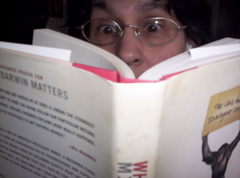
This is this week's reading.

Tuesday, April 03, 2007

Detroit

I have, unfortunately, no pictures on this one.

We toured Detroit today (April 2). The level of poverty we saw almost defies despcription. Not two blocks from Grosse Pointe Farms, accross Alter street lay block after block of damaged, burned, and collapsing buildings. Many built between 1870 and the 1940’s, closely placed and run down, they lack paint, they lack electricity, and there was evidence of at least one which lacked indoor plumbing.

People were sparse, though a group of four or five young children played in front of one of the houses. Very thin, they looked at our vehicle (a large RAV4) with half-hearted wonder as we drove past. Many blocks had swaths of overgrown and garbage-strewn lots which had been bulldozed. The only businesses in view were churches. At least one house of worship could be seen for every two blocks. Also, run down, they offer only the false hope of a nonexistant god. A billboard which almost made me scream declared that “You can be saved by Jesus”.

The answer to the poverty brought into what had once been a working class neighbourhood does not lie in this direction. The decades-long decline- closings of factories and the ripple effects of local businesses shuttering as workers leave or run out of money will not be reversed by prayer, no matter how earnest.

Very near to downtown Detroit is a neighbourhood which in 1993 saw the deaths of seven children in a housefire which has become known as the Mack Avenue Fire. With officials originaly scapegoating the parents, it became clear due to a citizens’ commission that the children (the youngest one just 7months) were victims not of parental neglect, but of poverty and systemic neglect.

Their water had been turned off- unknown to the parents, as the utility company sent no word of the shut off- for non-payement of the bill. ($225 at that point). The father, who held an accounting degree, but who had most recently been employed in the peripheral construction business, went into the basement under the impression that the pipes had frozen. This was February, so it was not irrational to think so. His attempt to heat the pipe with a small flame of course did not bring water through to his family. It did, however, set the unpainted beams of the house smoldering. The fire broke out later that afternoon, when the parents were out scavenging metal to sell for scrap- their only source of income.

The tragedy was compounded by the lack of up-to-date equipment for the fire department- including equipment to remove window bars- a common fixture of the houses in the area.

In the course of the citizens’ inquiry, it beame clear that, far from unusual, this family’s story was too too common. The closings of the factories starting in the 1970’s removed the sources of income and hope for gaining other employment for broad layers of the working families in the area. Even a four-year degree did not help this father find a place to earn a wage.

Many people owned their houses, so leaving the area for work was difficult on the family members who would be left behind, and there was scant hope of selling a working class house in a time of economic decline.

Interestingly, the wealthy areas of Grosse Pointe and Grosse Pointe Farms, built during the same era, suffered not a whit. The houses there- a great number of them mansions, including one of Henry Ford’s houses, are as well-kept as ever. There are plenty of well-stocked stores, and a distinct lack of offers to Buy Your House Any Condition written on crude posters and plastered on poles and walls in the area. The yacht club remains undisturbed by the effects of mass unemployment.


Here is an article from December of 2000 about yet another house fire in the area which has some information on the Mack Fire, as well as on the cuts for firefighting in the area. I wish the article was no longer germaine. Sadly, the conditions not only persist, but have deepened in the area.

Thursday, March 22, 2007

This is the last time I'm going to talk about Harris- unless he continues to write stuff down

A recent review on the wsws.org of Dawkins' new book- ( http://www.wsws.org/articles/2007/mar2007/dawk-m15.shtml ) prompted a deeper look into Harris, with whom Dawkins has been hanging about. The company you keep, and all that. It's unfortunate thet Dawkins has become such a champion of Harris, and, indeed, I have for some time wondered if they are not just so fast because Harris is, it seems, seen as the Voice Of American Atheism.


Rationalizing Neo Colonialism-
The End of Faith:Religion, Terror, and the Future of Reason by Sam Harris (ww norton, paperback 2004)

Sam Harris has gained much attention with the publication of his books, The End of Faith, and Letters to a Christian Nation, as well as a number of op-ed pieces in various mainstream publications. He has been hailed within many atheist and generally secular communities as something of a Rationalists’ Savior. On the surface, his arguments against the current violent trends in fundamentalist religions seem something with which most people would agree. Digging deeper, though, one cannot help but see a disturbing lack of reason in Harris’ own thinking.

It is important to remember, when reading The End Of Faith:Religion, Terror, and the Future of Reason (ww norton, paperback), that the book was started on September 12, 2001. As such, the entirety is coloured by what could be described as a sort of philosophical trauma endured by the author. Despite its title, this is not so much a call for reason as a justification for the current policies of aggressive war and neo-colonialist expansionism.

Certainly, the grip which religions have maintained on the minds of so many people needs to be called into question. Indeed, there is much which religions have to answer for- from the suicide bombings perpetrated by many sects from Buddhist Kamikaze pilots, Palestinian Christians, and Islamic Jihadist to the suppression of scientific development and exploration, and unscientific anti-Darwinism. Much damage has been done, physical as well as psychological and social by religion’s call for ignoring the realities of the world in favour of attributing the unknown to the Unknowable. This perpetuation of ignorance has had a terrible effect on humankind. Too many politicians have used the Appeal to the Ultimate Authority to justify the most horrific deeds- often with the complicity of the Earthly religious institutions.

There is no denying that religion has its uses, most famously as “the opiate of the masses”, and there is no doubt that in these time we are seeing a re-administration of this most potent and deadly drug.

Certainly, we do need a call to Reason. This call, though, must itself be reasonable. This is where Harris fails.

Harris' first book is rife with cherry-picked Koran passages and blatant misrepresentations of Islam in particular. The book starts off with an imagined bus ride in which a young man blows himself and others to smithereens. Though much of what we do not know about this person is pointed out, it is only to ask, "Why is it so easy...to guess the young man's religion?"

"Given the vicissitudes of Muslim history, however, I suspect that the starting point I have chosen for this book- that of a single suicide bomber following the consequences of his religious beliefs- is bound to exasperate many readers, since it ignores the painful history of the Israeli occupation of the West Bank and Gaza. It ignores the collusion of the Western powers with corrupt dictatorships. It ignores the endemic poverty and lack of economic opportunity that now plague the Arab world. But I will argue that we can ignore all of these things- or treat them only to put them safely on the shelf- because the world is filled with poor, uneducated, and exploited people who do not commit acts of terrorism, indeed who would never commit acts acts of the sort which has become commonplace among Muslims; and the Muslim world has no shortage of educated and prosperous men and women, suffering little more than their infatuation with Koranic eschatology, who are eager to murder infidels for God's sake." (109)

Here we have the crux of Harris' argument; that in trying to find the root cause of the problems we now face and in determining our future course, we must ignore history and objective social forces in favour of the simple explanation that Islam is the sole source for all anti-western sentiment.

Throughout the book, he conflates Islam and "The Muslim World" with terror. While it is understandable as an immediate emotional reaction to the falling of the WTC, it has no place in a plea for rationality.

Misleading statements abound. One in particular, on page 123 Harris cites the following quote:
"Sayyid Qutb, one of the most influential thinkers in the Islamic world, and the father of modern Islamism among the Sunni, wrote, "The Koran points to another contemptible characteristic of the Jews: their craven desire to live, no matter at what price and regardless of quality, honor, and dignity." He comments, " This statement is really a miracle of concision. While it may seem nothing more than a casual fillip against the Jews, it is actually a powerful distillation of the Muslim world view."

This sounds pretty serious. But is it accurate? Even a little outside reading proves it not to be.

First, let us identify Sayyid Qutb. Born in 1906 in Egypt, he moved to Cairo as a teenager to further his education. Not particularly religious, he was known to not even observe the friday evening prayers. His two-year visit to the US in the late 1940’s exposed him to the rampant consumerism and comparatively "loose" behaviour of the post-war boom years. He returned to Egypt disgusted with what he saw and joined the Muslim Brotherhood- hardly a mainstream organization even then. He was jailed for activities with the MB when they openly opposed the government of Jamal Abdul Nasser.

His shaky knowledge of Islamic law, combined with his harsh prison experience gave birth to a radicalized splinter religion wherein traditional interpretation relying on looking at both other passages of the Koran and the Haadeeths gave way to Qutb’s proclamations.

Though his views and methods gained popularity in certain politically disillusioned circles, it is hardly representative of Wahabi or Sunni Islam, nor even of the majority of sects within. It is certainly not the predominant view of "the Muslim world." To claim otherwise is a serious distortion. One must ask why the distortion is there.

In addition to this kind of “mistake”, he adds deliberately provocative turns of phrase- for example, referring to the "twin terrors of Koranic literalism" (p. 34), an obvious reference to the World Trade Center. Another passage: "Yes, the Koran seems to say something that can be construed as a prohibition against suicide- 'Do not destroy yourselves' (4:29)- but it leaves many loopholes large enough to fly a 767 through..." (pg. 33, emphasis mine.)

There is also a 5-page (118-122) stretch of selected Koranic exhortations to do violence onto unbelievers of various sorts. While it makes for chilling reading, one could as easily cherry pick a comparable selection from the Bible (Old and New Testament) or just about any other holy book. That the Koran is over-represented in Harris' book there can be no argument. It could well be asked why the Bible is not so represented here. It is an easy game, to pick out atrocities from these holy books, but what is it meant to accomplish?

One has to question Harris's facile identification of “acts of terrorism” with the Arab masses. Those Islamic fundamentalists who pursue a reactionary policy of individual terrorism (mostly against innocents) and the justified struggle against the occupiers are not politically equal. Second, the “poor, uneducated, and exploited Muslims” did not commit “acts of terrorism” until recently. One then must wonder why the Arab/Muslims, whose countries have been occupied or dominated by one or another imperialist power for close to a century, chose this period to engage in such actions. Which then raises the question of the fragmenting of (and sometimes just plain exterminating of, as in Iraq in the 1970's) the socialist/progressive opposition within the Arab countries. Finally, “Collusion of Western powers with corrupt dictatorships” surely begs the question: where did both the Shah of Iran and Saddam originate from other than the machinations of the CIA? Whose military placed the Saud dynasty in power? For that matter, who funded bin Laden in Afghanistan?

Aside from the pervasive anti-Islamic-in-particular bent, some of what Harris writes is quite reasonable. Take for example, the following, found on page 35:

"We live in an age in which most people believe that mere words- "Jesus", "Allah", "Ram"- can mean the difference between eternal torment and bliss everlasting. Considering the stakes here, it is not surprising that many of us occasionally find it necessary to murder other human beings for using the wrong magic words, or the right ones for the wrong reasons. How can any person presume to know that this is the way the universe works? Because it says so in our holy books. How do we know that our holy books are free from error? Because the books themselves say so. Epistemological black holes of this sort are fast draining the light from our world."

At one point (page 180) we find:
"I believe that [cultural] relativism and pragmatism have already done much to muddle our thinking on a variety of subjects, many of which have more than a passing relevance to the survival of civilisation.

"In philosophical terms, pragmatism can be directly opposed to realism. For the realist, our statements about the world will be "true" or false" not merely in virtue of how they function amid the welter of our other beliefs, or with reference to any culture-bound criteria, but because reality simply is a certain way, independent of our thoughts. Realists believe that there are truths about the world that may exceed our capacity to know them; *there are facts of the matter whether or not we can bring such facts into view.*"

By "realism" Harris it can be assumed to mean philosophical materialism. But why doesn't he use the world materialism? Harris is not a dialectical materialist but a vulgar materialist. As Engels showed in his pamphlet on Fuerbach, vulgar materialism inevitably leads back to idealism because it is unable to deal with the question of social man, real man living in class society. Society is not simply an amalgam of individual egos, but an organism with its own historical laws of development determining social consciousness.

Perhaps due to the trauma of 9/11/01, there seems, a *lack of willingness* on Harris' part to bring some facts into view.

Moving through a selective history of Christianity and Judaism (particularly the Inquisition and the Holocaust), Harris paints a bleak picture of the misuses of faith to suppress and subdue the general population. Along the way, however, a major assumption takes form- that religion itself is to blame for the woes wrought by those wielding it. There is no discussion on the forces outside of religion which bear on the beliefs or the people holding them. There is a distinct lack of historical perspective- only faith - in the form of religion- is to blame. While it can generally be agreed that religion has a lot to answer for, to view it as the be all and end all of motivating factors is to view history with a rather large blind spot.

He briefly decries the "political religions" represented by Stalinism and Maoism. Though it is certain that blind faith in any entity, real or imagined, is a danger it is interesting that he does not tackle more current personages. It is also interesting that these two, figures of the supposed left, are highlighted. Why, it must be asked, are not past fascists’, nor the present Bush Administrations uses of religion brought into question? Where is the examination of the neo-cons’ mobilization of the religious right to gain and keep power? An examination of the use of religion as driver of fear in the current climate would be very useful, indeed. This is, however, not Harris’ thesis, as we see.

While it is true that religion has been a method for the oppression of and promotion of backwardness within the masses within class society, the whys are herein largely ignored in favour of a surface examination of the what. Who benefits from the ignorance and obedience of the people in question? This question is not asked. It is also not answered beyond a brief mention that some of the property seized during the Inquisition made it into the hands of the Church and that rewards for turning in "witches" were sometimes offered to an impoverished peasantry. Not mentioned are the similar rewards offered for turning in “enemy combatants” in Afghanistan. The political motivations of the Holocaust are unexamined, though they are very briefly acknowledged ("Nazism evolved out of a variety of economic and political factors, of course, but it was held together by a belief in the racial purity and superiority of the German people" pg. 101).

While, on page 140, Harris states, "We have surely done some terrible things in the past. Undoubtedly we will do terrible things in the future. Nothing I have written in this book should be construed as a denial of these facts, or as a defense of of state practices which are manifestly abhorrent.", he makes no bones about the real source of evil in the world. Ultimately, it is religious faith alone which must be held accountable. It is only the reaction of Islamic Extremists which should be called into question, not the political and economic forces which have shaped the lives of so many in the Middle East and Africa. In Harris' view, the recent uptick in violent incidents can have nothing to do with being subject for so many years to the economic interests and military incursions by the Occidental powers.

His starting point is meant to frighten the Western Mind. The Man on the Bus is both alarming and unrepresentative. While religion has been used through the ages to justify the most atrocious acts, to dismiss out of hand the forces surrounding and shaping the beliefs in question is grossly irresponsible and only serves to incite fear. For what purpose?

Ignored also is the increasingly mid and upper-class makeup of the terrorist leadership in question. Osama himself (a follower of Qutb, no less) comes from the moneyed class and essentially bought his way to the top. How ignoring the facts of history can be called "reasonable" is beyond understanding. Confusing the uses of religion with religion itself will not lead to reasonable thought and action.

Religious tolerance is also given a smack by Harris- he states, partially correctly, that those who preach tolerance and soften the harsher aspects of their religions to better function on modern society do not do anyone any favours, as they serve to perpetuate religion itself and show too much leniency for the excesses of fundamentalism. Harris' views are all or nothing- either be a fundamentalist or get rid of your faith entirely. If you're a fundamentalist (particularly Islamic), get ready to die.

The End Of Faith paints a gloomy picture of reason's future. For Harris, the methods of dealing with extremism called for are the very same for which he decries the extremists. He states (on pages 52/3 of the paperback edition), "Some propositions are so dangerous that it may even be ethical to kill people for believing them. This may seem an extraordinary claim, but it merely enunciates an ordinary fact about the world in which we live."

While it is true, as he avers early on, that "there is no talking to some people", his answer to the problem is still more reactionary killing. His methods of applying reason are as faulty, selective, dogmatic, and blind as he claims faith to be. This is not entirely surprising, as twisting history to suit one’s needs is a common occurrence when dealing with the ruling classes. It is alarming, however, coming from someone claiming to be a scientist (Harris, according to his bio, is currently working on a doctorate in neuroscience “studying the neurological basis of belief, disbelief, and uncertainty.”), as it flagrantly disregards any observance of the scientific method.

A call for reason is indeed needed at this time- perhaps more than ever before- but this book is not that call. Rather, it serves to justify yet more oppression, less understanding, and further war in the name of defeating a religion which is grossly misrepresented both in practice and in population within these pages. It turns the use of religion as a means of oppression on its head in its call for the use of a Fear Of Religion as the new weapon.

In this Straussian bit of myth-making worthy of any neo-con, Harris helps to created an Enemy Worth Fighting for our age. His insistence that faith alone (ie religion) is to blame for the world's troubles is narrow and misleading. His focus on Islam as the Worst of the Worst is both facile and useful to the ruling classes in their current conflicts. While, as Engels points out, "we simply cannot get away from the fact that everything that sets men acting must find its way through their brains", Harris falls into the trap of assigning one and only one possible course of action to the Islamic faiths. He also displays willingness to believe that everything follows from religious faith without regard for forces political, social, or historical. To exclude from the analysis the economic and political elements involved begs the question of what master Mr. Harris is serving. Reason is betrayed by such obscurantism.

As socialists, we realize the long history of oppression wrought in the names of various religions. We absolutely reject the continuance of superstitious and backward thinking represented by religious faith. Just as strenuously, though, do we reject the reactionary calls to war- new crusades- supposedly in the defense of "reason" or “civilization”, which only serve to once again pit worker against worker, human against human, for the ultimate gain of the moneyed classes.
It is in the vital interest of the working class to shake off the controlling hand of religion- to be able to view the world rationally, reasonably, and clearly without appeal to “higher powers”. Such appeals serve only to keep ignorance and oppression well-fed.

It is likewise vital to recognize that the absence of religion does not always equal the presence of reason. Though those such as Harris would have you think otherwise, religion is not the only driver of actions.

Friday, March 02, 2007

Why Darwin Matters might not be the book for me

I'm still working on it, but there have been a couple of disturbing developments. The biggest one is the chapter "Why Christians and Conservatives Shouls Accept Evolution". In this chapter is a sub-chapter titled "Evolution and the Conservative Theory of Free Market Economics". In this sub-chapter is a comparison between Darwin's theory of natural selection and Adam Smith's theory of the invisible hand-

"Charles Darwin's theory of natural selection is precicely parallel to Adam Smith's theory of the invisible hand. Darwin focused on showing how complex design and ecological balance were unintended consequences of individual competition among people. The natural economy mirrors the artificial economy. Conservatives embrace free market capitalism, and they are against excessive top-down governmental regulation of the economy; they understand that the most efficient economy emerges from the complex, bottom-up behaviours of individuals pursuing their own self-interest without awareness of the larger consequences of their actions."

Let's pause for a moment here.

Though conservatives may embrace this idea- is it true? Do the best systems evolve (if you will) in an arena of unencumbered self-interest? Further, the question must be asked- "Best for whom?" Society at large? Doubtful, if history is any example.

Anyhoo- still reading it....Well, more truthfully, still trying to find where the kid put it....

Sunday, February 18, 2007

Salt Lake City Shootings and such

There was, when I was there in the mid-1990's, a growing Bosnian and Russian population. Most of the Bosnians (and some Sebs) were fleeing violence. Salt Lake being what it is- insular, homogenous, and isolated in spite of having an international airport- these populations kept pretty much to themselves. Most were not LDS, and this put them out of the mainstream. Muslims were "not even Christian", and so even further out of the main.

This past week saw a horrific shooting by a young man who was of the Bosinan community in Salt Lake.

Since this person had been a toddler, he had been subject to huge amounts of violence- direct threats to his existance which go far beyond the school tauntings often associated with these sudden outbursts of violence. He likely never got any kind of counseling for it, and living in Salt Lake, where there is a large, likewise scarred, Bosnian population served to both isolate and re-traumatise what was already a pretty shaky foundation. Being muslim in Salt Lake is no picnic, and being Muslim in Salt Lake with massive trauma and post 9/11 suspicion of Muslims is something I don't even like to think about.

Does any of this excuse what happened? No. Absolutely not. But it did not happen in a vacuum and maybe understanding what happened and why can prevent things like this from happening again.

The long-term effects of war are something we'd better learn to deal with, given both the number of returning war veterans and war survivors this world is going to have.

Given that we send people in to commit what was done to this young man, and that no re-conditioning is de rigure for returning combat vererans- given that seeking help of the psychological kind ias something which can endanger a military career, and given the number of people who are fleeing war, and often ending up here or in otherwise alien cultures, the isolation and trauma will only serve to create more situations such as the one in Salt Lake.

Sunday, February 11, 2007

Why Darwin Matters and some other stuff

Why Darwin Matters, Michael Shermer, Times Books- hardback, $22.00 (eek!)
(Subtitle- The Case Against Intelligent Design)

I've just started this book, and have got through the prologue, and the first two chapters. The prologue makes a nice little dismissal of the continuing relavence of Marx, but I'm going to let that slide for now. It also goes into some interesting information about the author himself- he was at one time an evangelical, dinosaur-denying Christian. Education put a stop to that. He's now a regular columnist for Scientific American magazine as well as publisher of Skeptic magazine.

The first chapter is a darned good briefing on what evolution is- dispelling many of the myths used by the ID arguers, and giving a concise timeline and explanation of Darwin's discoveries and the implications thereof.

Chapter two- which I am going to re-read for further writing- is entitled "Why People Do Not Accept Evolution". In this chapter, Shermer brings up an interesting point when he says

"There is, however, a greater threat to the theory of evolution today: not from those who resist evolution, but from those who misunderstand it. Most people know very little about evolution, and this makes it easier for the people who do not accept evolution to encourage others to question the theory, even to the point of denial."

This is, I think, a very important point. For many, evolution is often accepted, sort of. Not understood, but taken for granted as what happened. One could argue that at least they acept it. I don't think that's enough, though. I will certainly admit that my own knowledge in this area is lacking, but, hopefully, growing.

Evolution is especiallly tricky, though, as so many other elements of scientific investigation and knowledge rest on this theory. Geology, biology, chemistry. It is also important to know what evolution is *not*. From defining the words involved (particularly "theory"), to the process of events, the lack of knowledge has given the proponents of anti-scientific modes of thought much leeway.

"If we decended from apes, why are there still apes?" "How come there are no transitional fossils?" Just two of the questions born of, and preying on, the lack of knowledge and understanding involved.

End of part one.

Charming picture pre-hairbrush:


Oh, yes, this reminds me- did you know that goosebumps are an evolutionary remnant of our "monkey days"? Indeed, just as other furry animals have the ability to puff up in anger or for size-maximizing appearance, goosebumps would, had we kept our hair, do the same for us. There, vesitges of our ancestors.

Friday, February 09, 2007

Problems revisited

There's a lot in Problems Of Everyday Life (Trotsky) to consider. One of the essays involved rudeness- and the rudness of the revolutionary comes into question. About that section, I wrote:


If, after the revolution, leaders are seen as condescending, the problem of counter-revolutionary actions will grow. The workers who will fight for the revolution will as soon give it up if they see their concerns brushed aside by the future leaders of revolution in the same dismissive manner as that of the elites of today.

I would like to clarify this somewhat, in light of a recent event.

While I still think people should be polite whenever possible, I do also very firmly believe that counter-revolutionary ideas should not be nurtured, and should indeed be cut off at the first sign of appearance (once a mistake, twice a tendency). In *political* discourse, it is of the utmost importance to seperate the personal from the political. If, then, a worker advocated something which would undermine the revolution, to call that worker's dedication into question would be justified. If, after explaining why their idea was not within the interests of the revolution, they persisted, it would be wise to not associate with that person.

This is not to say that a revolutionary leader can go around making personal remarks about workers (or others) and get a free pass- but on the subject of revolution, the personal is immaterial. To take having an idea shot down (for whatever reason, really, but *with reason*) as personal is a mistake.

Friday, January 05, 2007

List

I am sorta reading:

Darwin's Dangerous Idea by Dennett
Imperial Life in the Emerald City by Chandrasekaran


And Scientific American Magazine.

I seem to be taking a few months' break. Time management has been kind of a bear.

Friday, October 27, 2006

Working and Reading

It's hard. Boo and hoo, of course, but it is. I actually have a chance to read something today and am going to start with the Sam Harris book.


I told my friend about this book, and she said, "Letters to a Christian Nation? There's a problem right there." It is interesting to note that he has titled what is meant to be a book in argument (or continuation of argument) for secularization so. I am hoping it will prove to be a tongue in cheek excersize on his part, though, after The End Of Faith, which purported to be a plea for rational thought, my hopes are slim. We'll see.

This brings up some thoughts, though- how open a mind should a person keep, in the face of the obvious? Carl Sagan said that keeping an open mind is good, but not so open that your brains fall out.

---more later.

Later:

Friday, October 13, 2006

New Books

My new list of books I'll be reading soon-
The End- Lemony Snicket
Letter to a Christian Nation- Sam Harris


I will also be re-reading The Walter Mosley book, too.

Thursday, October 12, 2006

Holy Crap- New posts coming soon.

So, as is my way, I got very busy, forgot my password and did not post for a long time, BUT- I have been....reading. "What?" you may ask- and you may. A lot, I will answer. Tune in possibly tomorrow for more.....

Well, maybe not tomorrow, as the new Lemony Snicket is coming out and I have all 12 previous books in first editions and...yes, I am like that. Soooory- here's a cute cop to mollify you:

Friday, May 05, 2006

Colbert in brief

Interesting article at WSWS today on the Stephen Colbert speech at the White House Press Correspondents' Dinner.


Also interesting is that Youtube, suddenly concerned about "copyright infringement" has taken the Colbert portion of the CSPAN coverage of the diner down. They have left Colbert Report clips and CSPAN clips (including the unfunny "comedy" routine of Bush himself and a Faux-Bush) up. The dinner took place on April 29. Today is May 5. That's some fast deletion. It's also "refusing to load" from other sources.

The Comedian Dissapears?

Tuesday, May 02, 2006

Old Fish, New Fish

There is an article at WSWS about the discovery of the Tiktaalik fossils. I am saddened, though not surprised, given the current anti-scientific bent in the States, that this has not recieved more coverage.

What often baffles me is the Creationists' self-denial of the Wonder involved in scientific discovery. For me, and many like me, I am hoping, the Wonder that is based on the real is so much better than the Wonder which comes with the denial of further possible discovery. Knowing a little, and that there is so much more to be known, and which is knowable, is very exciting.

Obviously there are many differences in Scientific Knowledge and Religious Knowledge. It is often the case that religious study goes from pre-drawn conclusions and gathers in only the evidence which would support the views held, while rejecting anything which runs contrary as being the Devil's Work, or Heresy (it was not until the 1990's that the Catholic Church pardoned Galileo).

(This is from quite some time ago. While I am working on Why Darwin Matters, I thought it might be slightly relevent.)

Thursday, April 27, 2006

Identity Politics. Pre-reading qualms

The Book is Life Out of Context by Walter Mosley- which I have finally found (it was under another book).

The qualm-provoker is this, from the back cover:

..."proposing that African-Americans have to break their historic ties with the Democratic Party and form a party of their own."

Allow me to set all my preconcieved notions and ideas about Mosley down in print here, or many of them, anyway. I've read a number of his books, fiction and non-, and have found that there is an overwhelming amount of thought displayed within. He's not only thinking, but able to beautifully (yes, beautifully) communicate. From his mysteries (most famously the Easy Rawlins series) and science-fiction (I highly highly recommend Futureland) to the wonderful non-fiction essay of Workin' on the Chain Gang, he knows what to do with a word. He is one of my favourite living writers, let's just put that out there right this minute.

I remember first reading an Easy Rawlins mystery- the mystery itself is almost inconsequential, really, when one considers the chartacter of Easy. A World War II vet, Rawlins is black in America in the suceeding decades. Living in LA, but born and raised in New Orleans, Rawlins is unable to escape the conflict between the ideals of America- the promises of equality- and the reality of racism and poverty. What struck me most was the integrity of the man, and of the writing behind him. It's like a calm before the storm conversation. Zer gut.

My concern is that Mosley might let the colour issues blind him to the more unifying issue of economic disparity. There can be no denying that race has been used (be it colour-based designations or simply "they are from there, we are from here" ones) throughout the ages as a dividing factor by the powers that be. I do not think he is blind to the suffering of people just because they fall out of his hue zone, as it were- that this is not the case is reflected in much of his fiction writing- but that the race issue might be blinding him to a broader solution.

I am hoping that my fears will be allayed. I'll be reading this one this week.

Friday, April 21, 2006

Unchained melodies which sometimes incorporate chains melodically

Einsturzende Neubauten in one form or another has been producing music of one sort or another for over 25 years now. Industrial is as close a description as I can provide- though with the caveat that it is only called this because jackhamers, air compressors and metal bits (some big, some small) are included in the arsenal of instruments.

Headed by Blixa Bargeld, this mostly-German group has produced hundreds of songs ranging from the earsplitting to the lullabic. Over the past few years, they have abandoned the usual record-contract route (having been screwed multiple times by various labels) and taken to the net. Their last three albums have been produced with money raised by selling subscriptions to their listeners. They have also financed a small, and perhaps final, US tour.

It seems, in talking to Mr Bargeld backstage after their Washington, DC show in 2004, that they are encountering increasing financial barriers to touring in the States. Large cuts are taken by the venues, and often the band will lose money even on a sold-out house, if they do not sell enough merchandise during the show. On that tour, they also had to pay a fee to clear channel in order to use the technology which enabled them to sell cds of the shows to the audience members at the show.

Though they maintain a steadfastly close-mouthed on exactly where their political allegiances lie, Blixa was heard to remark, in reference to the possibility of this being their final tour, "This is the problem with capitalism." Most of their supporters seem to have leftish leanings of various sorts, and it is argued that one song, Sabrina, alludes to a wish for anarchy (the colours of the German flag are dismissed one by one until only black remains as the colour Blixa's voice wishes "would be your colour").

I made a number of attempts to get an interview with Herr Bargeld on his recent solo rede/speke tour. I was unsuccesful, and wonder if the prospect of being interviewed for a socialist publication was the reason. Oddly, I am not inclined to hold it against him if this is the case, given the band's dedication to their music and maintaining their artistic freedom.

The method they have chosen is an unusual one, in that they both retain the right to mix and produce as they see fit (and in their own time, at that; it can take years for the records to reach the supporters) and allow the supporters to see and hear works in progress and give opinions and suggestions. The band checks in on the forum from time to time, yet is not a slave to it- there are very few times when advance warning is given as to when they will be online.


Their latest production- released to supporters only- is Grundstuek, which uses everything from television noise, feedback and the ubiquitous springs to dropped objects and voices either solo or en masse. From the openings of Good Morning, in which a teacher's voice (in English) and that of her class are heard and then give way to the bass and bass spring and Blixa (in German), to the close of Tagelange Weisse, with its eerily comforting digitalness, the whole work is one of unity not often heard. Their earlier works were heavy on the clang, and this still shows through on a number of tracks, but they have, over these twenty-odd years, mellowed a bit as well. Unlike many acts of equal or longer duration, they have not lost the excitement at creation- rather, they have learned to use many voices, loud and soft, to greater effect than the sustained and desperately juvenile screeches and subject matters of a Rolling Stones or an Arrowsmith.

To say they have re-invented themselves would be inaccurate, as they are still, despite the changes in lineup, Einsturzende Neubauten. They differ only in that they have grown and learned, they have not gotten stuck- they have retained the freedom to use sound. They are unconstrained.

Thursday, April 13, 2006

Family life, women and children and men

From the Old Family to the New is another essay in the Problems Of Everyday Life. This one was originaly published July 13, 1923 in Pravda. Eighty-three years on, we still wrestle with these issues.

Isolated excerpts- in order of appearance:
-Domestic life is more conservative than economic, and one of the reasons is that it is still less conscious than the latter. In politics and economics the working class acts as a whole and pushes on to the front rank its vanguard, the Communist Party, accomplishing through its medium the historic aims of the proletariat. In domestic life the working class is split into cells constituted by families. The change of political regime, the change even of the economic order of the state--the passing of the factories and mills into the hands of the workers--all this has certainly had some influence on family conditions, but only indirectly and externally, and without touching on the forms of domestic traditions inherited from the past.

A radical reform of the family and, more generally, of the whole order of domestic life requires a great conscious effort on the part of the whole mass of the working class, and presumes the existence in the class itself of a powerful molecular force of inner desire for culture and progress. A deep-going plough is needed to turn up heavy clods of soil. To institute the political equality of men and women in the Soviet state was one problem and the simplest. A much more difficult one was the next--that of instituting the industrial equality of men and women workers in the factories, the mills, and the trade unions, and of doing it in such a way that the men should not put the women to disadvantage. But to achieve the actual equality of man and woman within the family is an infinitely more arduous problem. All our domestic habits must be revolutionized before that can happen. And yet it is quite obvious that unless there is actual equality of husband and wife in the family, in a normal sense as well as in the conditions of life, we cannot speak seriously of their equality in social work or even in politics. As long as woman is chained to her housework, the care of the family, the cooking and sewing, all her chances of participation in social and political life are cut down in the extreme.--

-In regard to family relations and forms of individual life in general, there must also be an inevitable period of disintegration of things as they were, of the traditions, inherited from the past, which had not passed under the control of thought. But in this domain of domestic life the period of criticism and destruction begins later, lasts very long, and assumes morbid and painful forms, which, however, are complex and not always perceptible to superficial observation. These progressive landmarks of critical change in state conditions, in economics and life in general, ought to be very clearly defined to prevent our getting alarmed by the phenomena we observed. We must learn to judge them in their right light, to understand their proper place in the development of the working class, and consciously to direct the new conditions towards socialist forms of life.

The warning is a necessary one, as we already hear voices expressing alarm. At the conference of the Moscow party propagandists some comrades spoke with great and natural anxiety of the ease with which old family ties are broken for the sake of new ones as fleeting as the old. The victims in all cases are the mother and children. On the other hand, who in our midst has not heard in private conversations complaints, not to say lamentations, about the "collapse" of morality among Soviet youth, in particular among Young Communists? Not everything in these complaints is exaggeration--there is also truth in them. We certainly must and will fight the dark sides of this truth--this being a fight for higher culture and the ascent of human personality. But in order to begin our work, to tackle the ABC of the problem without reactionary moralizing or sentimental downheartedness, we must first make sure of the facts and begin to see clearly what is actually happening.--

It is unfortunate that we are not living in a state of communism- ie, shared working in the domestic sphere. Too often, the majority- still- of the housework and child-rearing does fall to the woman. I am not saying that this is unimportant work- but it is work which must be shouldered by all parties involved. If a household breaks up, it is the "mother and children" which are most at risk of sinking into poverty.

Too often, due to cruel economic realities, Beth Shulman's statement in "The Betrayal of Work" that the worst thing which can happen to a woman is to get pregnant is proven. She notes that this is the quickest way into poverty. I know from personal experience that this is so.

Much is at stake when we speak of the relations between men and women. (Husband and Wife aside, down to brass tacks here.) Women still find themselves subject to the whims of biology- but this need not be so; beyond the obvious bearing of children, the abilities of men and women are equal in potential. It is in the social structure of home and worklife where we encounter the makings of inequality.

To reconstruct family life- in whatever configuration you choose- it is imperative that responsibility for houseworkk and the care of children be fully shared. The division of labour is one thing- yes, shared chores make for a lighter load on the women, they also make for a better view of what is involved in domestic life. So much work goes un-noticed, let alone misunderstood. It is a matter of personal responsibility and respect- how banal to have to say "Those shirts don't fold themselves". But it is just such mundane things which make up every day life. It is the preocupation with such things which leaves little time for revolutionary activity or education. It also leads to the consideration of the housewife as just that and nothing more. The mind of the woman is discounted, as "what would someone who only keeps house or cares for kids know"?

Quite a bit about inequality, as it turns out. Especially if both parties also work outside the home.

As for children and the care thereof, we see today vast numbers of single-parent homes. These homes are much more likely to experience poverty and hunger. The children are often left in situations where inadaquite care is taken of them or they are completely unattended. They are left, at too young an age, to fend for themselves. Add to this issues of abuse and the picture becomes grim indeed. The lack of willingness on the part of the (most often) fathers to properly care for their children is appalling.

It does not lead to revolutionary thought- it does lead to anger in many cases, and often enough to individual acts of reactionary violence or association with questionable groups (Republicans, Nation of Islam), which pretend to offer what is missing.

"The easiest problem was that of assuming power." Writes Trotsky in this same essay. These are surprising words, I think, to many people. It seems to be the view of many to whom I speak that there is a sort of magical formula- get power away from the bad guys and we live happily ever after. I have heard this in many forms- from Democrats, from Anarchists, even from some Socialists.

This is only the begining, though! Changing the manner of governance will only solve some of the problems- one must change the very basic structures of everyday life on the way to true equality.

So, what to do? It is not exciting to think about- but it must be accepted that after the initial revolution, there is the daily life. How should it be lived? Obviously, equality must be integrated into the most mundane of things even down to the level of the very basic- One person washes, another person dries the dishes. The dishes get done.

Rudeness part 3- new aristocracy part one

----We still have, however- and herein is the chief stumbling block- the rudeness of the old aristocracy, with the touch of feudalism about it. This kind is vile and vicious throughout. It is still with us, uneradicated, and is not easy to eradicate.--

In the States we have a new sort of aristocracy, based, much as the old aristicracy, on the assets, but less so on the ancestry.

There is almost the celebration of the rudeness of the rich- an expectation on both their part and the part of the "rude-ee" that it is a right. After all, this millionaire (more often billionaire now) must have worked hard to gain this amount of money. In respect to that hard work, we grant a pass to the cruelty- perhaps we will gain by it somehow.

When we do not gain by it, the blame is placed on us- we didn't try hard enough to please. What is left unconsidered in this deference is that there is much more likely a sweatshop, a factory or an office full of people who worked very hard to get this person rich.

The addage that genius is 1% inspiration and 99% persperation is interesting to consider in that 99% of the profits seem to rise to the top 1%. What is not so often considered is that a big idea is only so big if the manpower is not given to put it into effect. The skills of architects amount to pretty pictures if the skills of construction workers are not engaged. In the end, though, the architect is celebrated, while the construction worker is off working.

In light of this, it's also interesting to note that the rudeness of the aristocrat is expected and relished ("he *talked* to me!"), while any slip by the worker will bring warnings to "know your place", though not always in those terms. This is part of why it is so very difficult to uproot. Until we stop accepting rudeness from any quarter, we can expect it from every quarter.

Though, in the States, we are given the illusion that "all men are created equal", we have not yet internalised it, if I may use a psychological term, and demanded what that would imply- that an equal opportunity should follow to become the best that we can, and that we all possess equal dignity and to be accorded equal respect.

We are given the idea, through films and books and news stories, that anyone can rise to the ranks of the billionaire- if we do not, it is our own fault. Therefore, those who do must be deferred to. They are heroes. They are worthy of respect, when we, so poor, so lowly, what are we?

The story we are not given daily is that behind those billionaires stand those sweatshops, those factories and offices wherein people work for a pittance, are subjected to inhumane treatment and threatened with the loss of what little they have if they dare to complain. They go home to find, spread accross the pages of the newspapers, or blaring from the television, more stories about the rich and famous behaving very badly and reaping rewards for it.

Too tired to protest, they fall into bed and dream about one day winning the respect they deserve.

Wednesday, April 12, 2006

New Orleans- because I also read newspapers

The best and the worst.

The best are the people - ones I know and many whom I do not- who go there to help dig people's houses (and sometimes people) out. They are the ones who keep me from just giving up entirely on the idea that humanity is absolutely doomed. And they are normal, and they are like you and me, except that they do these things which are amazing.

The worst are the ones who have the means but not the will- or who have the means and use their will to keep things from getting done. They make me wish there was a hell. That's not very charitable, I know, but neither are they. I am talking about people who have private helicopters and used them during Katrina not to pluck people off the roofs, but to import their own private armies to patroll their neighbourhoods. They are the people who were vacationing and claimed to have no warning and no news of the situation until three days into the hell that these people lived through- or died in.
No names, I think we all know of whom I speak.


from the article:
***"We never reached out to anyone to tell our story, because there's no ending to our story," said Wanda Jackson, 40, whose family is still waiting for word of her 6-year-old nephew, swept away by floodwaters as his mother clung to his 3-year-old brother. "Because we haven't found our deceased. Being honest with you, in my opinion, they forgot about us."

She continued, "They did not build nothing on 9/11 until they were sure that the damn dust was not human dust; so how you go on and build things in our city?"

In October and November, the special operations team of the New Orleans Fire Department searched the Lower Ninth Ward for remains until they ran out of overtime money.

Half a dozen officials of the Federal Emergency Management Agency rebuffed requests to pay the bill, said Chief Steve Glynn, the team commander. When reporters inquired, FEMA officials said the required paperwork had not been filed.****
(NYT april 11)

my hands just sit on the keyboard at this point- what can be said that has not already been said? yet it is so very important not to let the conversation die out. How can these people be forgotten? How is it that they are so callously brushed aside? I well remember 9/11- and who could forget, with the constant intonation of "everything changed on 9/11" and the flags flags flags? Two big buildings go down and we are Standing United or the Terrorists Win.

A region is deluged, a city destroyed and it is unknown how many are dead, and we are asked to turn away as the deadlines for hotel accomodations pass, as the leaders drag along and offer excuses about paperwork not being filed and funds being limited and all the while we are asked to look away.

Do not think about this- do not talk about this- do not note that those who suffered most and continue to suffer most are those who were suffering in dire poverty to begin with. They must have somehow brought it upon themselves- they should have just left- never mind that they had no means to go- no money for fares, no cars. Never mind that they've been in poverty for generations while others sit on the high ground, with their guards in place- imported at great cost.

More than conversation- it is imperative that we not let actions die out.

Tuesday, April 11, 2006

Probs Pt 2- More rudeness, I tell you!

The second sort of rudeness is that of the Revolutionary.

In my expereince in DC I came accross many politicians and political types (no, really!). One thing which I noticed accross the spectrum was that, after a certain level of hierarchy had been reached, a certain amount of politeness fell away. The result was that the person would become unapproachable. It also worked in the ostensibly less-heirerchical groups- once someone had published or organized a certain number of artcles or actions, they became likewise unapproachable and, dare I say, a bit vain and dismissive in their attitude.

The matter of unapproachability is important in that, to create a revolution, we cannot act as exhalted individuals- there is not a monoply, as they say, on good ideas. There is also a great deal which can be learned from unexpected- and previously untapped- sources. If you shut yourself off from people- to say nothing of The People- how can you fight for and with them?

As for actual rudeness or dismissiveness toward people- to act in such a manner is to disrespect the work and value of the people. This is not way for a participant- never mind a leader!- to behave.

We are workers. No matter what we have published, what we have done, how many signs we might have carried, above all, we are workers. To discount the experiences of fellow workers, their insights into the ills of society and their willingness to participate in the revolution, is counter-revolutionary at its core. To treat any fellow worker- no matter how seemingly unenlightened- with anything other than respect begs the question of our fitness as revolutionaries.

Yes, we'd prefer that all workers were advanced. That would make our jobs easier- but this is not the case. Those who can be reached will not be persuaded by condescension- this is what they can expect at the hands of the elites- this is never what should be received from a revolutionary.

I am not saying to pretend to be nice- no. If someone attacks, you are right to defend yourself. But if someone approaches with what seems, perhaps, to be a "stupid question", to treat them as if they should already know what they now wish to have explained will never win them to the side of revolution. It will, though, reinforce the elite's claim of leftists as being elitists. Again with the irony. Again, too, with the self-defeating behaviour. If, on the other hand, you treat the question with the same weight with which it is asked, you will open the way to learning- both for you and for the person with the question.

If, after the revolution, leaders are seen as condescending, the problem of counter-revolutionary actions will grow. The workers who will fight for the revolution will as soon give it up if they see their concerns brushed aside by the future leaders of revolution in the same dismissive manner as that of the elites of today.

Thursday, April 06, 2006

Halfway through Problems of Everyday Life pt 1- ignorance

This is a series of editorials and speeches given by Trotsky in the years following the Revolution of October 1917. This volume (Monad press, 1973, third edition, 1979) incorporates the book *Problems of Life*. Covered within are areas ranging from habit (including spitting, family and gender roles) to hard science and the teaching thereof.

Many people ask what a post-revolutionary world or society would be like- the assumptions today are fairly dystopic, with anything from re-education camps to flat out enslavement and annialation prophesied as excuses to avert revolution. To be sure, there would be a period of comparative chaos, but this is where the true test of a revolution lies. Post revolution (as act of overthrow) there is the building of society anew. There are shards of the old society which must be thrown off still- habits die harder than governments.

In the essay which originally appeared in Pravda on April 4, 1923, Civility and Politeness as a Necessary Lubricant in Daily Relations, we find nothing to which even Miss Manners could raise an objection. Trotsky takes on the manner in which the state addresses the people, how the population is treated. He also tackles forms of rudeness-

--But our rudeness itself is not homogeneous. There is the simple rudeness of peasant origin, which is unattractive, certainly, but not degrading. It becomes unbearable and objectively reactionary only when our young novelists boast of it as of some extremely 'artistic' acquisition. The foremost elements of the workers regard such false simplicity with instinctive hostility, for they justly see in the coarseness of speech and conduct a mark of the old slavery, and aspire to acquire a cultured speech with its inner discipline. But this is beside the point...

Side by side with this simple kind, the habitual passive rudeness of the peasant, we have another, a special kind- the revolutionary- a rudeness of the leaders, due to impatience, to an over-ardent desire to better things, to the irritation caused by our indifference, to a creditable nervous tension. This rudeness, too, if taken by itself, is, of course, not attractive, and we dissociate ourselves from it; but at bottom, it is often nourished at the same revolutionary moral fount, which, on more than one occasion in these years, hs been able to move mountains. In this case what must be changed is not the substance, which is on the whole healthy, creative and progressive, but the distorted form...

We still have, however- and herein is the chief stumbling block- the rudeness of the old aristocracy, with the touch of feudalism about it. This kind is vile and vicious throughout. It is still with us, uneradicated, and is not easy to eradicate.--

I will stop there, though Trotsky did not, as he goes on to discuss red tape and the composition of and fight against it.

Let's talk about rudeness and its uses for a moment, though. As he points out, there are several kinds of rudeness, that of ignorance and the habit of being oppressed, which serves to keep the illiterate and uncultured in 'their place'; that of the revolutionist, who in their drive to accomplish things, lets civility slip- which is, as noted by T, someting which needs changing; and that of the aristocrat, which is born of a sense of entitlement and which is used as a weapon to keep others at a distance.

On the first kind- we do see this even today, of course. "Street cred" is something which is fought for (often literally), and to attempt to improve one's mind is often derided as "being all bougzhie", or "acting uppity". The getting of good grades in certain circles is seen as somehow selling out (it has been brought up most recently as a problem in African-American circles, but it is certainly not limited to this area. If I may lodge in your head a very bad song from the 1980's- Billy Joel asks "Should I try to be a straight-A student?", and answers by way of choral arrangement that, "If you are, then you think too much").

The stereotype of the "egghead" serves a role in society, whether the nerds get their revenge or not. Those who think are seen as hopelessly sexless, ill-socialized, and often badly dressed. Why? Whom does it serve to keep people from thinking- and thinking critically at that? The answer is pretty obvious- a stupid and illiterate population is easier to fool, and easier to oppress. Let us not forget that there were laws against teaching blacks to read in the United States. Their oppression was an economic imperative.

Today educationall funding is being cut accross great swaths of the country- the poor, who attend public schools, are often sent on ahead whether they have achieved literacy or not. The children of the elite are given tutoring in areas which are deemed important for future success. This, combined with a misguided and self-defeating denigrating of "thinking too much" serves only to perpetuate the cycle of oppression.

While it can certainly be argued that the public schools will teach what the government approves, it must also be noted that without the very basic tools of literacy (both verbal and numerical), there is no hope whatever of advancement either as a knowledgable participant in revolution or within the capitalist system. So it is as simple as this: The capitalist system benefits from the ignorance and subsequent "marking by uncouth manners" (if you will) that is entailed.

Other entities benefit, too, from such things. There are movements which will gladly prey on the ill-informed (religious ones spring to mind immediately, though they are by far not alone).

The pressure from within to not "act all boughzie" is particularly insidious. Wearing ignorance as a badge of valour plays directly into the hands of "the man" who is so oppressive. The defining of oneself as "not playing that game", no matter how it is put, precludes oneself from freedom. KNOWLEDGE is power, not ignorance.

The idea, closely connected with this, that having a modicum of civility and respect for your fellow human beings is also "acting boughzie" or otherwise playing into the hands of "the man" and therefore that to treat people with rudeness is necessary to maintain credibility within one's social circle is not only alienating, but also actually does play into the hands of the powers that be. If you cannot have a calm, straightforward and informed discussion with someone, you cannot foment revolution.

Do not mistake wanton violence and rioting with revolution- a conflation which is often made both by the (rightfully) extreemly angry and the quasi-leftish trust funded youth at university- revolution is a creative action. Though some windows might get broken along the way, this is not the goal- the goal is to build a better society which is designed for the good of the workers, not to leave everything in rubble. Knocking down is only half the way there. To stop amidst the shattered remains of the buildings of commerce and say "we have defeated them" is to allow the contracters to come in, rebuild with stronger materials and crack down on the freedoms of expression.

To knock down properly, one needs the plans for what is to be built either from the remains of the materials or from the new. In order to know what needs knocking down and what can be made- what should be made- in its stead, you need to have a solid revolutionary theory in place. In order to get that solidity, you need to be able to examine the options as they are- not just as you are told they are. You need not only literacy to examine the words, you need the critical thinking skills to place those words in the context of the actions taken by the speakers (do they match, the words and the actions?), and you need a knowledge of history and its driving forces.

Capitalism relies on a certain amount of ignorance- the less people know of their history, of the rights fought for and won, the less capitalism has to cover up. The less perspective people have, the more often we will hear phrases justifying current conditions with a skewed comparrisson to past ones- "You think you have it bad because your pension is being cut, well, at least you aren't a twelve year old factory worker, so you really have no complaint". That we had to fight so hard to get twelve-year olds out of the factories in the States and Europe is left out of the equation- had they their way, twelve year olds would be back in the factories in more places. Certainly they'd rather they had them there than possibly learning to read in the schools.

It would be a whole lot easier, say the elites, if people "Knew their place". Ironically, we hear much the same thing in the hurling of accusations of "acting boughzie" of the oppressed. In keeping hold of the traditions of crudeness and illiteracy, we keep tight hold of our chains and make it unnecessary for the elites to strangle us since we do such a good job of it ourselves.